
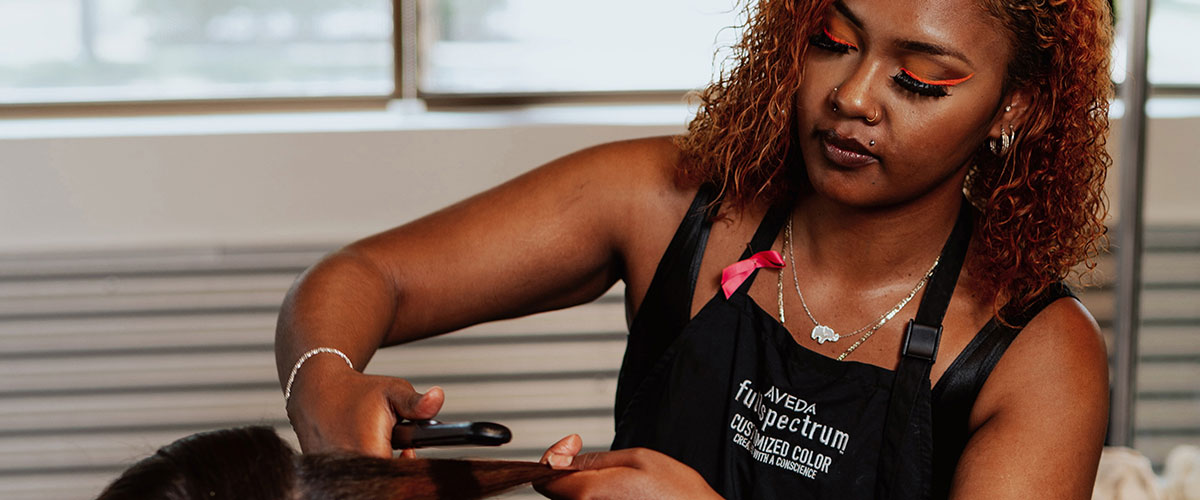
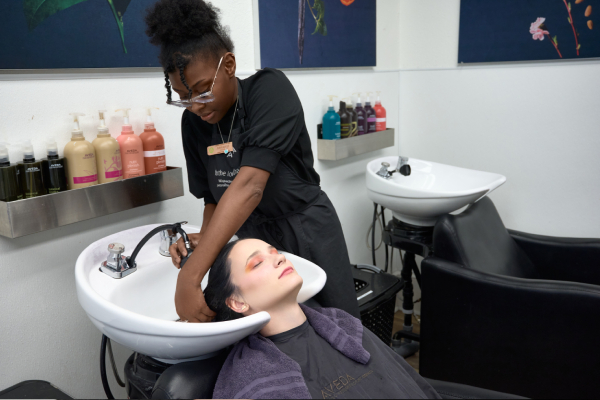







Texture-Inclusive Education Cutting, Styling, and Barbering Across All Hair Types
Not all hair can be styled the same. At Inspire Greatness Aveda Institutes, our goal is to foster a class of hairstylists and cosmetologists who embrace the full diversity of hair types, textures, and densities. Our texture-inclusive training begins from day one and is a top priority in our Hairstyling, Barbering, and Cosmetology programs. Here, we discuss how we equip students to handle different hair types with skill and confidence.
Key Takeaways
- Different hair types and textures respond differently to cutting, styling, and products.
- Our programs teach cultural competence and consultation language so that students can discuss hair history, needs, and maintenance with clarity and sensitivity.
- We also train students in a full range of hair cutting, styling, and barbering techniques for straight, wavy, curly, and coily hair.
What Does Texture-Inclusive Mean?
First, it may be helpful to define what texture-inclusive styling means. Human hair comes in a wide range of textures, including straight, wavy, curly, coily, and those that fall in between. Each texture has a different density or porosity, making it respond differently to hair techniques and products. Texture-inclusive training helps students learn to handle all different hair types. You’ll be taught how to consult with clients, analyze their hair, and provide an appropriate cut, style, and finish.
Not every school offers texture-inclusive training. Finding one that does, however, can greatly benefit your career. Diverse instruction leads to greater confidence with different hair types, fewer unpleasant surprises, and a wider client base that trusts you with their hair.
Client-First Consultation
Texture-inclusive hair care begins with culturally sensitive consultations. Students learn the language to discuss various hair types appropriately. You will also learn how to cover important topics, such as:
- Awareness of cultural bias and stereotypes
- Discussion of lifestyles and hair care needs
- Impact of haircare history on its health
These conversations will help you understand the person’s hair goals, requirements, and limitations, which will all inform your recommendations and methods as a stylist.
Texture Science Essentials
Hair types are distinguished by not one, but two factors: curl pattern and texture. Curl pattern refers to the shape of hair, which can be straight, wavy, curly, or coily. It breaks down further into subtypes from 2A to 4C. Hair texture, on the other hand, refers to the thickness of the individual strand and the density of the hair, or how many strands grow per square inch of scalp.
Both are key to understanding how to treat hair. Curl pattern defines how hair forms naturally and how it responds to different types of manipulation, including heat styling or being tied back. Hair texture, meanwhile, influences how well hair absorbs various products. Very fine hair may need lightweight products to avoid weighing it down. Coarse hair, on the other hand, holds styles better but needs more moisture to stay lush.
Haircare by Technique
Finally, texture-inclusive courses go into detail about haircare techniques for different textures, shapes, and densities. This list is not comprehensive, but it will give you a good idea of the types of skills you will develop:
Cutting Techniques
- When to cut dry or cut wet
- Tension control and elevation
- How to manage shrinkage with length mapping and test coils
- Curl-by-curl and structured layering
- The difference between debulking and removing length.
- Fringes and face-framing layers with waves, curls, and coils
Styling and Finish
- Prep, cleansing, and conditioning
- Blow-dry methods and safe heat ranges
- Twist-out, braid-out, and roller sets
- Definition vs. volume
- Considerations for protective styles
Barbering
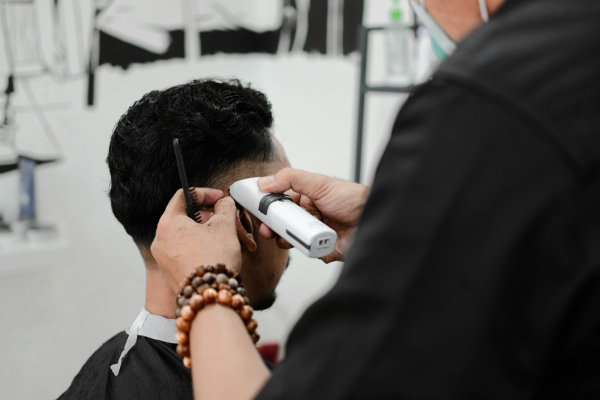
- Guard selection and lever control
- Barbering with or against the grain
- Fades, tapers, and lineups on dense textures
- Beard shaping
- Enhancement products
Learn Hair Cutting and Styling for Different Hair Types
Learn how to cut and style different hair types with confidence at Inspire Greatness Aveda Institutes. Our haircutting, barbering, and cosmetology programs cover all hair types and textures, from 1a to 4c, to prepare students for every type of client. Our admissions team can help you learn more about our programs, enrollment, and financial aid options. Contact us today to schedule a campus tour in Denver, Colorado; Provo, Utah; or Phoenix, Tucson, or Avondale, Arizona.
Hair Texture FAQs
Do you teach both wet and dry cutting?
Yes, we teach both wet and dry cutting for curls and coils.
Do you cover consultation language and cultural competence?
Yes, we cover these topics.
What clipper techniques change on highly textured hair?
Highly textured hair changes almost all clipper techniques, requiring you to significantly change your approach when cutting and barbering.